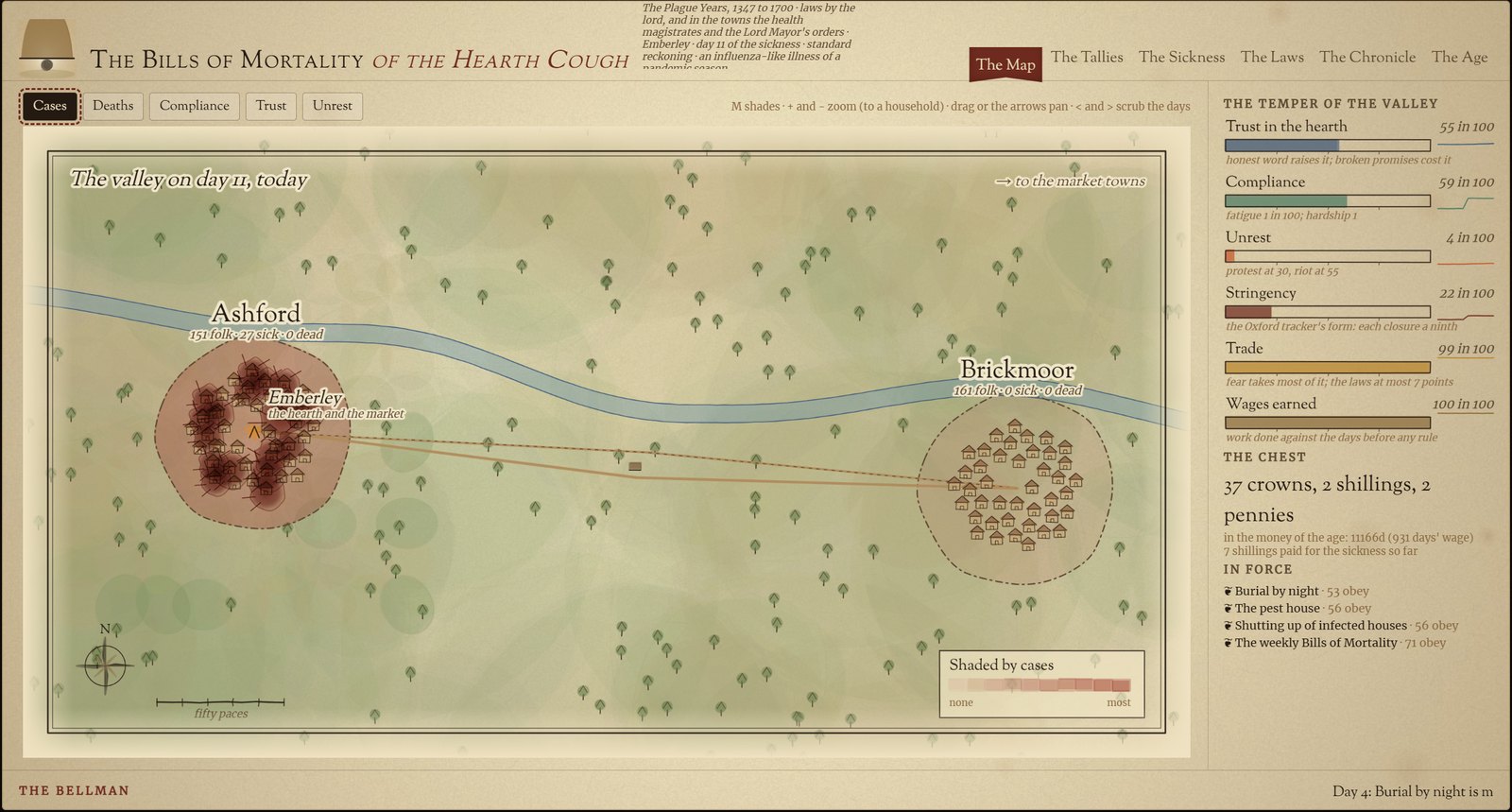
A game about how sickness moves through a village and how people answer it, set in the living valley of Commonwild. Every number in it carries its source, and the game says plainly which numbers are still assumptions.
The design paper sets out three ways to play. One is in the build today; two are planned.
Govern through the charter and the Moot. Pass laws from a book of 26, pay for them from the chest, and live with the vote, the grumbling and the cost.
Walk the valley with the healing trade, keep a case book, trace who met whom and find the source. The healer's ward is in the build; playing the healer as your seat is planned.
A strategy mode where you are the sickness. Every trait stays inside the published range for that kind of illness, so the game never makes a sickness stronger than nature has.
The sickness spreads through the folk's real homes, workplaces and market, stepped once per game hour with seeded draws, so the same seed replays the same outbreak exactly. Three sicknesses invented for the valley (the Hearth Cough, the Well Flux and the Fen Fever) are built from 31 cited sources. Laws work through people: compliance tires over time and with hardship, trust rises with honest word and falls with broken promises, and when a law bites too hard folk protest, riot, trade on the black market or flee, carrying the sickness with them. A researcher's mode runs the same valley without the game, about half a second per run of 280 folk, and writes CSV files and a manifest so a run can be repeated. Contagion sits in the main build behind a rule pack that is off by default. It is not on sale.
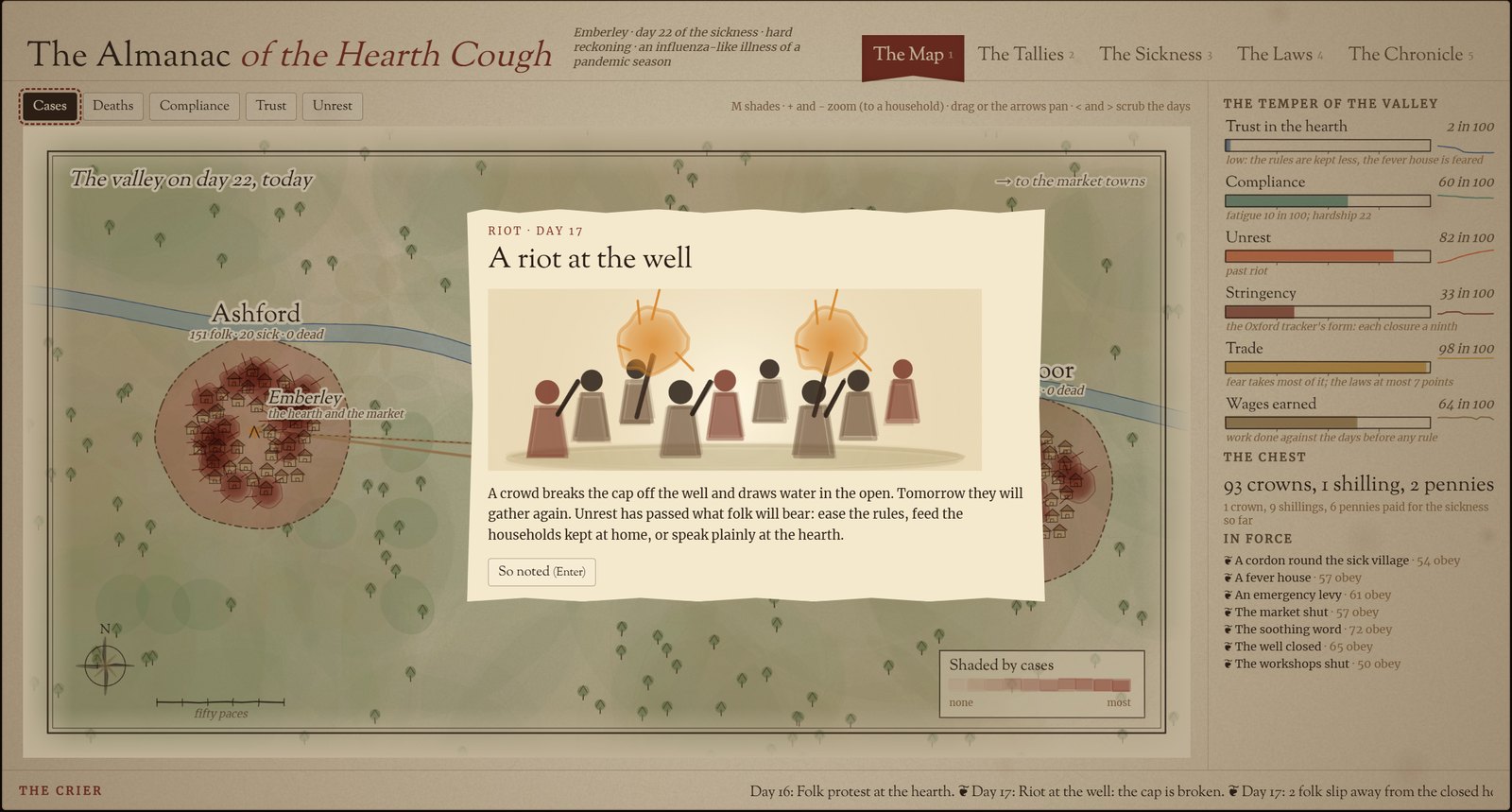
Press L and the Almanac opens: a parchment-and-ink map with five shadings and zoom down to a single household, seven painted charts with a day scrubber and a ghost line that shows the same valley with no laws, a plate of what is known about the sickness and what is only suspected, illustrated law cards with their evidence, event cards such as a riot at the well, a crier's ticker and a chronicle of the outbreak. A real in-game screen.
Choose the era when you make the world. Each era offers only the laws its people actually had, under their period names, and later measures show as Not yet cards. Vaccination laws appear only where a vaccine existed. News and rumour travel at the speed of the period, costs are counted in period money, and 13 population groups each react in their own way.
Laws made by the lord, and in the towns by the health magistrates and the Lord Mayor's orders: burial by night, the pest house, shutting up infected houses, the weekly Bills of Mortality.
The Board of Health and the town council, under the Public Health Acts of 1848 and 1875: a cordon sanitaire, the cholera hospital, removal of the sick.
The city's board of health and the mayor, by ordinance: schools closed, public gatherings banned, theatres, churches and saloons closed.
The state health department and the national government, with the WHO's advice.
Health departments, courts and legislatures. Public fear drawn from Gallup polls of US adults in 1987 and 1988.
The health ministry and the city's medical officer of health.
National governments and health ministers by emergency regulation, and the states and regions, measured against the Oxford COVID-19 Government Response Tracker.
National governments and health ministers, with powers some legislatures have narrowed.
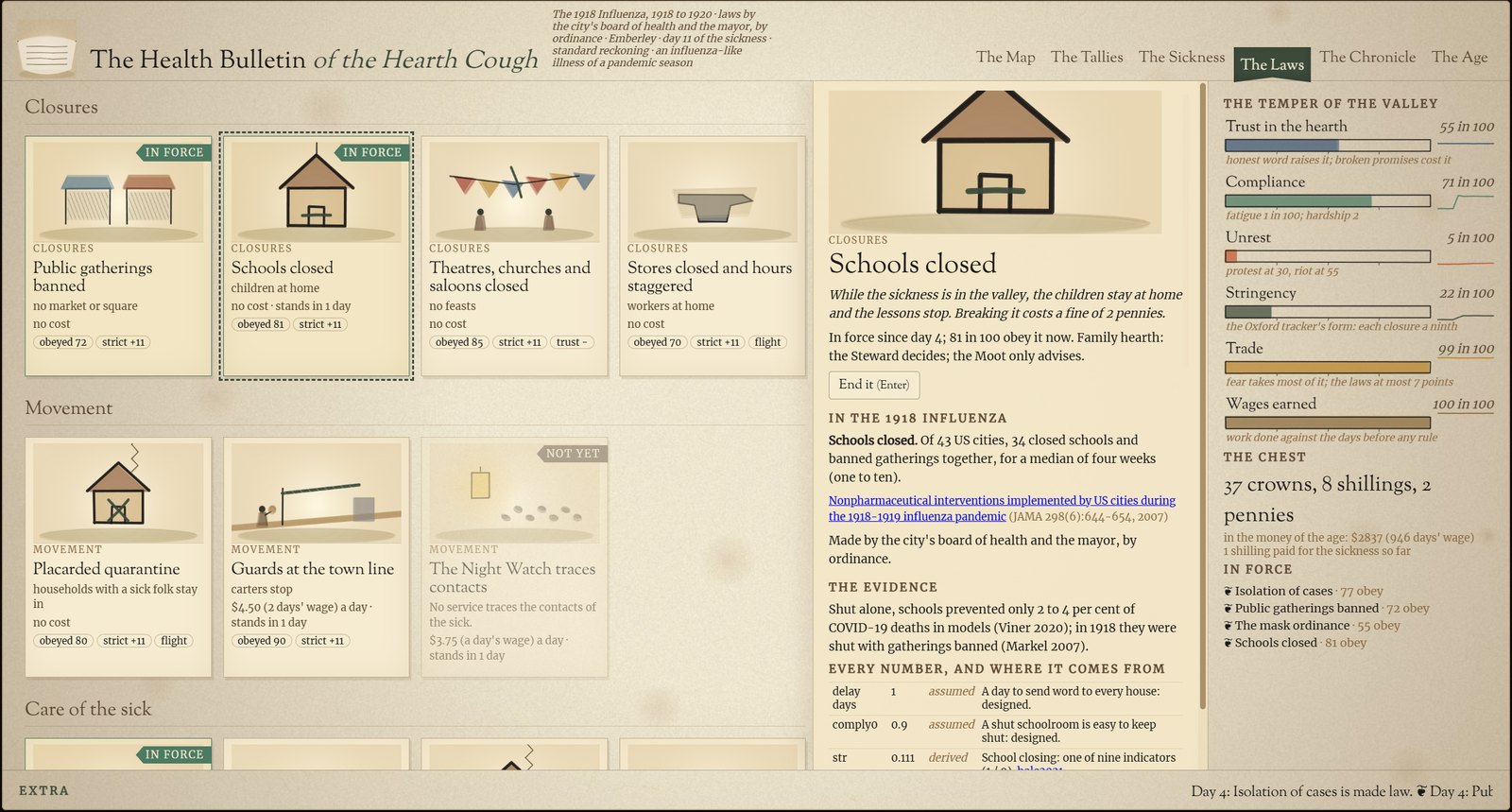
Every card says what a law costs in the money of the age, how long it takes to stand and how many folk obey it, and opens to its history and its sources. In the cholera century the compulsory vaccination card stays Not yet: England's acts of 1853 and 1898 were against smallpox, and there is no vaccine against the valley's sickness. A real in-game screen: closing the schools in 1918.
Every number is marked as published, derived, calibrated or assumed. Of the 154 numbers behind the laws and public reactions, 11 are published values, 41 are derived, 1 is calibrated and 101 are still assumed, each with a note. Of the 174 numbers in the era packs, 11 are published, 26 derived, 1 calibrated and 136 assumed. The era packs draw on 55 sources, among them the Oxford COVID-19 Government Response Tracker and Gallup polls of US adults from 1987 and 1988. The model does not yet pass its own historical checks: against the 1854 Broad Street cholera outbreak its band covers 0.56 of the observed days where the target is 0.80, and its 1918 ratio of early to late peaks is 0.738 where the cities recorded 0.12 to 0.5. Until those checks pass and an outside epidemiologist has reviewed them, there is no research licence on sale.
Contagion is a game, not a medical tool, and it gives no medical advice. It works at the level of people and populations only: the sicknesses are invented for the valley from published numbers, and nothing in the game describes how any illness is made, grown or changed. A content check refuses any sickness without a source, and any named after a real disease. For your own health, ask your clinician or your national health authority.